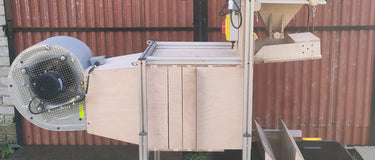
The Winnow Wizard is a density seed separator widely used by small seed producers in the US. The machine creates a laminar flow of air that separates seeds based on density. Because this airflow is highly uniform, the WW offers much greater accuracy than traditional wind winnowing, allowing for fine cleaning and significantly improved seed quality.
Since starting Seeds of Scotland in 2023 we have been steadily increasing the volume of seed we have been producing at our farm here on the Cromarty firth, the majority of which has been processed entirely by hand (pictured - winnowing kale seeds by hand).

As the scale of our production increases we have found ourselves in search of machines and equipment to speed up and improve our seed processing. This search in itself has had many challenges as there is very little equipment out there suitable to our scale. Furthermore, the equipment that is available is very expensive. Our search naturally switched to the USA where there is a thriving small scale seed production industry.
We came across a machine that had been developed in the Pacific North West of the states, by a seed grower called Markeal Luterra. He had designed and built the ‘Winnow Wizard’ to fill this gap in production scale and cost. Furthermore, in the open source spirit of seed saving the plans of this machine are freely available for anyone to download from his website so that you can build your own. However, although plans are readily available, they are specific to USA materials, measurements and wiring regulations making building a Winnow wizard in the UK a larger and more technical job than necessary.
We could see how the Winnow Wizard could significantly improve our seed production capacity, efficiency and quality and could also see a barrier to ourselves and others in the UK to others building it. So we put together a plan to convert the plans and publish a UK version of the Winnow Wizard.
The project gained momentum after meeting Adam Veitch at the Seed Sovereignty Gathering in Invergordon in 2024. Adam (pictured below) is a Chartered Engineer who co-runs a small croft near Fort William and has a strong interest in grain and small-scale food production. He has previously contributed to the development of open-source seed equipment, including the Tiny Oat Collider impact dehuller—making him ideally placed to lead the adaptation of the Winnow Wizard for UK use.

So in 2025, after securing funding from the Pebble Trust*, Seeds of Scotland worked in collaboration with Adam to develop UK-specific plans and instructions for building Markael Luterra’s open-source seed cleaning machine, known as the Winnow Wizard (WW). The goal was to remove the practical barriers that had made the original US plans difficult to build for folks in the UK.
The first step involved translating the plans from imperial to metric and updating the electrical design to comply with UK wiring regulations. At the same time, all key components—screens, containers, fasteners, and electrical parts—were substituted with items readily available from UK suppliers.
Finally with the adapted design in place, Adam moved onto building a full working prototype to be used and tested at Seeds of Scotland. This stage allowed the updated plans to be tested in practice, revealing small but important refinements to make assembly smoother and more user-friendly. Once the prototype was complete It was then transported to Seeds of Scotland, where it will be used to clean seed from the winter 2025/26 season onwards.
*Established in 2014, the Pebble Trust is a charity based in the Highlands of Scotland that provides grant funding for projects supporting a more sustainable, fair, and low-carbon society.
Download the UK-WW plans here:

Acknowledgements: Massive thank you to Markael Luterra, Adam Veitch, and The Pebble Trust for making this project possible.
Open Source License: Winnow Wizard - Metric UK version © 2025 by Darachbeg Croft in collaboration with Seeds of Scotland is open source material licensed under Attribution 4.0 International. To view a copy of this license, visit Creative Commons BY 4.0. Please refer to Plans – Markael Luterra for the prior art open source plans.
